

Most agencies build the website first and do SEO later. We do it backwards. Here's exactly how The Frontload Technique got a window cleaning business inbound leads in two weeks flat — without spending a single dollar on advertising.
4 leads. 14 days. Zero ad spend.
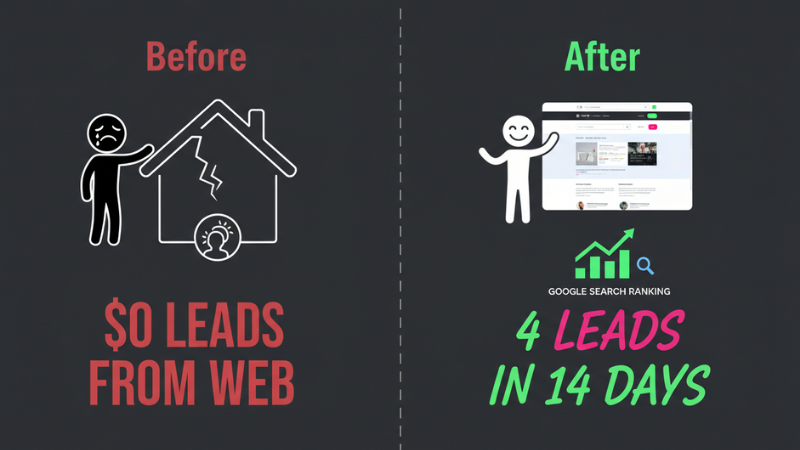
That's what happened when we applied The Frontload Technique to Peregrine Window Cleaning — a home service business that was getting all its customers from door knocking. No website generating leads. No Google presence. No way for potential customers to find them online even though they were delivering great work in their area.
This isn't a hypothetical. It's not a “what could happen” scenario. These are real numbers from a real business. Sam, the owner of Peregrine, sat down with us on camera and walked through exactly what changed when his site went live.
Here's the full breakdown of what we did, why it worked, why most agencies get this completely backwards, and what it means if you run a trade business that still depends on finding customers the hard way.
Before: Door Knocking, Word of Mouth, and Hoping for the Best
Before we built the site, Peregrine Window Cleaning had no online presence generating leads. Zero. Sam, the owner, was doing what a lot of trade business owners do — waking up early, driving to neighborhoods, knocking on doors, and hoping someone answered who needed their windows cleaned.
If you run a service business, you know this grind. You finish a job, and instead of more work waiting for you, you're back to prospecting. You're the technician AND the sales team AND the marketing department. Every customer has to be chased down individually. There's no system bringing people to you.
“Before we built the site, most of our leads were coming through just mainly door to door and word of mouth and referrals.”
— Sam, Peregrine Window Cleaning
The frustrating part? Peregrine was doing great work. Customers were happy. They had good word of mouth within the people who already knew about them. But being good at your craft doesn't automatically mean customers can find you. And in 2026, if you're not showing up when someone searches for your service in your area, you don't exist to the majority of potential customers.
Think about it from the customer's perspective. Someone in Sam's service area needs their windows cleaned. What do they do? They pull out their phone and search “window cleaning near me” or “window cleaning” plus their city name. If Peregrine doesn't show up in those results, they're calling whoever does. And that's exactly what was happening — those leads were going to competitors who had a web presence, even if their actual service was worse.
Sam had the skills and the reputation. What he didn't have was visibility. That's what The Frontload Technique was built to fix.
Why Most Agencies Get This Completely Wrong
Here's the standard playbook most web design agencies and SEO companies follow. It's the same one that's been recycled for years, and it's the reason most small businesses wait 6+ months to see any results from their website:
Build the website first
Pick a template, drop in some stock photos, write generic copy. The focus is on making it look nice, not on making it rank.
Launch it
Go live and hope for the best. Maybe submit it to Google. Maybe not. The site sits there with zero SEO baked in.
“Do SEO” after the fact
Months later, start adding keywords to pages, writing meta descriptions, maybe creating some blog posts. Basically retrofitting SEO onto a site that wasn't built for it.
Wait 6-12 months
Tell the client “SEO takes time” (which is true, but it doesn't need to take THIS much time). The client pays monthly fees while waiting for results that should have started on launch day.
This approach treats SEO as an afterthought. Something you bolt on to a finished product. It's like building a house without plumbing and then trying to add pipes after the walls are up. You can do it, but it's going to take longer, cost more, and the result won't be as good as if you'd planned for it from the start.
The Frontload Technique is the opposite of this. We do the SEO work BEFORE the site ever goes live. The result? The site launches preloaded. It doesn't need to “catch up” because it was never behind in the first place.
The Frontload Technique: What We Actually Did
The Frontload Technique is five layers, stacked on top of each other. None of them work alone. Together, they compound. And the key difference is that all five layers are in place BEFORE the site goes live — not weeks or months after.
Here's exactly what we built for Peregrine, layer by layer.
Layer 1: Keyword Intelligence
The Foundation
This is the layer that makes The Frontload Technique different from everything else. The heavy lifting happens before launch, not after. Before writing a single line of code, before choosing a color scheme, before anything visual existed, we started with data. We ran a bulk keyword analysis of 700+ industry keywords related to window cleaning, exterior cleaning, and home services in Sam's market.
We weren't looking for the obvious keywords everybody targets. “Window cleaning” has massive volume but massive competition. We were hunting for medium-tail opportunities — keywords with real search volume that competitors weren't specifically targeting. The sweet spot where there's enough people searching to generate leads, but not so much competition that you'd need years and thousands of dollars to rank.
This isn't keyword stuffing — and that distinction matters more than most people realize. The general rule is that roughly 3% of the words on any page should be your target keyword. So if a page has 300 words, you cap that keyword at about 9 uses. Go over that, and Google doesn't reward you — it penalizes you. And penalties are the number one thing to avoid in SEO. A Google penalty can tank your rankings overnight and take months to recover from. Some businesses never recover.
That's why our approach is placement, not stuffing. Every keyword earns its spot through strategic positioning in natural, relevant content. Google is smart enough to detect when you're forcing keywords where they don't belong, and the consequences are severe. We stay within the safe zone while making sure every page is targeting the right terms — no guessing, no gambling with your rankings.
Every other layer in The Frontload Technique builds on this one. The keyword research becomes the blueprint for the entire site — what pages get built, what those pages say, what cities they target, how they're structured. Without this layer, the rest is guesswork. This is what makes the biggest difference.
Layer 2: On-Page SEO
Making Every Page Count
On-page SEO is about making each page on your site relevant and useful for the search terms you're targeting. It's the difference between a page Google understands and a page Google ignores. Here's what we did for every single page on Peregrine's site before it went live:
Title tags — the most important keyword placement on any page. Every title tag was written around a target keyword from layer one, kept under 60 characters, with Peregrine's brand name at the end. This is what shows up as the blue clickable link in Google results. Get it wrong and nobody clicks.
Meta descriptions — the preview text below the title in search results. Every meta description includes the target keyword naturally, stays under 160 characters, and reads like an ad. Its job isn't just to describe the page — it's to make people want to click.
Heading structure — primary keyword in the H1, secondary keywords in H2s and H3s. This creates a hierarchy that tells Google exactly what the page is about and how the content is organized. URL slugs use hyphens and include the target keyword. Image alt text and file names include relevant keywords so Google Image search picks them up too.
We also built individual city pages for each area Peregrine serves. When someone searches “window cleaning Eden Prairie” vs “window cleaning Minnetonka,” Google treats those as completely different searches. One generic homepage that says “we serve the Twin Cities area” won't rank for either. Each city page has unique content, unique meta tags, and targets the location-specific keywords from layer one. The result is a targeted page for every city in the service area, each one speaking directly to that searcher's location and intent.
Want to see how your site stacks up on-page? Run it through our Free SEO Audit Tool — it checks title tags, meta descriptions, headings, and more in seconds.
Layer 3: Technical SEO
The Stuff Nobody Sees
Technical SEO is the behind-the-scenes work that determines whether Google can actually find, read, and index your site. If you mess this up, your site goes missing from Google entirely. It doesn't matter how good your content is if Google can't crawl it.
Schema markup — structured data baked into the code that tells Google exactly what your business is. Name, address, phone number, hours, services, service area, reviews. Without it, Google has to guess. With it, Google knows. This is how you get those enhanced search results with star ratings, business hours, and phone numbers displayed right in Google. It's also increasingly important for AI search platforms like ChatGPT and Perplexity, which rely heavily on structured data to understand and recommend businesses.
Site structure and crawl depth — pages closer to the homepage are seen as more important by Google. Buried pages waste crawl budget and might not get indexed at all. We kept every important page within 3 clicks of the homepage and built proper internal linking so Google can navigate the whole site efficiently.
Core Web Vitals — Google measures three things: how fast the biggest element loads (LCP, under 2.5 seconds), how quickly the page reacts to clicks (INP, under 200ms), and how much the layout shifts while loading (CLS, minimal). Peregrine's site is custom-built with Next.js — server-side rendered, which means the content is fully loaded before it reaches the visitor's browser. Google can read every word without needing JavaScript. The site loads fast, scores high on Core Web Vitals, and gives Google zero reasons to skip over it.
We also set up the XML sitemap, proper robots meta tags for indexing, HTTPS across the entire site with no mixed content issues, and made sure there are zero broken links or orphan pages. All of this was in place before launch — not patched up months later when someone finally runs a site audit.
Test your own technical SEO with our free tools: Schema Tester to validate your structured data, and Crawl Checker to see if Google can actually find your pages.
Layer 4: Off-Page SEO
Authority Is Everything
Okay, we lied — not everything is pre-launch. Layers 1, 2, 3, and 5 are built before your site goes live. But this layer? This is what happens after. And if keyword intelligence is the foundation, off-page SEO is the determining factor of how fast your business actually grows. This is the layer that separates sites that sit on page 3 forever from sites that climb to page 1.
Here's where we need to kill a myth. “Content is king” is not true. Everyone in the industry repeats it because they want to sell you content packages. The logic sounds nice — just make “good” content and you'll rank. But search engines don't rank content based on quality. They rank content based on popularity. And popularity has nothing to do with how well-written your blog post is.
If it were as simple as writing good content, everyone would be on page one. Authority is what actually moves the needle. And authority in Google's eyes comes from one thing: backlinks. A backlink is when another website links to yours. It's a vote of confidence. And it's a confirmed ranking factor — not speculation, not theory, confirmed by Google.
But it can't be just any backlink. Link juice comes from high-authority sites. A backlink from a trusted, established website passes real ranking power to your site. A backlink from some random blog nobody reads? Almost worthless. And buying backlinks or spamming comment sections will get you penalized — Google will potentially remove you from search results entirely.
Real off-page SEO means reaching out to people who are likely to link to your site. It means creating content that would actually be valuable if you shared it with people in your industry — not content for content's sake, but content that someone would want to reference and link back to. Guides, original research, tools, templates, data. Things people naturally cite.
For Peregrine, we started building this authority foundation from launch — earning real backlinks from relevant, trustworthy sources. This is the layer that compounds the hardest over time, and it's the layer most agencies either skip or fake.
Layer 5: Analytics + Tracking
From Launch
You can't improve what you don't measure. And you can't prove ROI if you don't have data from day one. We installed Google Analytics 4, Microsoft Clarity, and Google Search Console before the site went live.
GA4 tracks who visits, where they come from, and what they do on the site. Clarity gives us heatmaps and session recordings so we can see exactly how visitors interact with every page. Google Search Console shows us which keywords are driving impressions and clicks, and whether pages are getting indexed properly.
This is how we knew Peregrine had 4 leads in 14 days. Not because Sam told us — because the data showed us. Every form submission was tracked. Every visitor's journey was recorded. We could prove exactly what was working and double down on it immediately.
Layer 1 of 5 — All built before launch
That's The Frontload Technique. Five layers, all in place before launch. The site didn't need to “catch up” on SEO because it was never behind. It launched already speaking Google's language. And the results proved it within two weeks.
Traditional SEO vs The Frontload Technique
Traditional Approach
- ✗Build website first, SEO later
- ✗Generic keyword targeting
- ✗One page for all locations
- ✗Schema added months later (if at all)
- ✗Analytics as an afterthought
- ✗3-6 months before any rankings
The Frontload Technique
- ✓Keyword research drives every decision
- ✓On-page, technical, and off-page SEO before launch
- ✓Schema, Core Web Vitals, site structure from day one
- ✓Authority building with real backlinks, not content spam
- ✓GA4 + Clarity + GSC tracking from launch
- ✓Leads within 14 days of launch
The difference comes down to timing. With traditional SEO, you launch a website that Google has never seen before. It has no authority, no indexed pages, no keyword signals. Google has to discover it, crawl it, figure out what it's about, and then decide where to rank it. That discovery process takes months. During that time, you're paying for a site that generates zero leads while you wait for Google to catch up.
With The Frontload Technique, the site launches with every signal already in place. Google crawls it and immediately understands what the business is, where it operates, what services it offers, and why it's relevant to specific searches. There's no guessing period. The site is speaking Google's language from the first crawl.
Think of it this way: traditional SEO is like moving into a new house and then spending six months renovating it while trying to live there. The Frontload Technique is finishing the renovation before you move in. Same result eventually — but one of them lets you start living your life on day one.
Most agencies don't do it this way because it requires more work upfront. It's easier to sell a “website package” and tack on SEO as a monthly add-on later. That model is better for the agency's recurring revenue. It's worse for your results. We'd rather you get leads in two weeks than pay us for six months of nothing.
The Results: 4 Leads in 14 Days, Zero Ad Spend
We sat down with Sam to hear in his own words what changed after The Frontload Technique was applied to Peregrine Window Cleaning.
Hear It Directly From Sam
Within two weeks of the site going live, Peregrine had 4 inbound leads. Not from ads. Not from cold outreach. Not from door knocking. People searched on Google, found Peregrine's site, and filled out the contact form because they wanted the service.
Let that sink in. A business that was 100% dependent on outbound prospecting — physically going to people's doors — had customers coming to them within two weeks of launching a website.
“This is amazing. I am getting people coming to me instead of me having to go for them for our leads.”
— Sam, Peregrine Window Cleaning
But the numbers only tell half the story. The quality of the leads was completely different from what Sam was used to. When you knock on someone's door, you're interrupting them. You have to convince them they need the service. You have to sell. With inbound leads, the dynamic flips entirely. These people already decided they needed window cleaning. They searched for it. They found Peregrine. They reached out on their own.
“They were warmer and they were easier to close and they felt like they wanted my service, so they were coming to me.”
— Sam, Peregrine Window Cleaning
Warmer leads. Easier to close. Higher close rate. And they all came through the website's contact form — which means Sam knew exactly where they came from. No guessing. No wondering if that flyer he handed out worked. The tracking from layer five gave him clear attribution.
“A lot of them mentioned that they came from the website, but all the other ones I knew that they did come from the website because there was a contact form there and there only.”
— Sam, Peregrine Window Cleaning
And then there's the part that changes everything for a trade business owner — the time and money savings. Door knocking takes hours. Gas, driving, walking neighborhoods, getting rejected at most doors. The website works 24/7 without any of that.
“It's the best feeling ever because I can save a ton of time on door knocking and it's super cost effective because I don't need to spend any money really on going out and getting those leads.”
— Sam, Peregrine Window Cleaning
Why The Frontload Technique Compounds Over Time
14 days and 4 leads is just the beginning. SEO is one of the few marketing channels that gets stronger over time instead of weaker. With paid ads, the moment you stop paying, the leads stop. With SEO, every month the site is live, it builds more authority.
Google's algorithm rewards sites that consistently provide relevant, well-structured content. Every month Peregrine's site is live, it accumulates more signals that tell Google: this is a legitimate, active business that serves this area. Rankings improve. More keywords get picked up. More pages get indexed. More people find the site.
The frontload gives you a head start. The ongoing SEO management makes those gains permanent and pushes them further. Content gets added. Pages get optimized based on what the data tells us is working. New keywords emerge as the site builds authority. It's a growth engine that accelerates, not decelerates.
When we asked Sam where he sees Peregrine going over the next year, his answer captured exactly why this approach works:
“I see it just ramping up exponentially and us getting more leads and needing less time out in the field knocking.”
— Sam, Peregrine Window Cleaning
That's the compound effect. Each layer of The Frontload Technique reinforces the others. The keyword research feeds the content. The content feeds the rankings. The rankings bring traffic. The traffic generates leads. The leads prove it works. And the data from the analytics tells us exactly where to push harder next month.
Here's what most people don't understand about search engine rankings: age and consistency are ranking factors. A site that has been live for six months with consistent, relevant content will outrank a brand new site targeting the same keywords — even if the new site is better optimized. That means every single day your frontloaded site is live and indexed, it's building a moat that competitors have to overcome. The longer you're in the game, the harder it is for someone else to catch up.
Compare that to paid ads. Google Ads, Facebook Ads, whatever platform — the moment you stop paying, you disappear. There's no residual value. You don't build anything permanent. Every dollar you spent last month bought you last month's leads and nothing more. SEO is the opposite. Every dollar you invest in optimization this month makes next month's results better. It's not an expense — it's equity in your online presence. The work we did for Peregrine in month one is still generating value in month two, month three, and beyond.
And the compounding isn't just about Google's algorithm. It's about behavior. When your site starts ranking for one keyword, Google tests it for related keywords. When people click your result and stay on the page (because the content is actually good), Google rewards you with higher positions and more keyword visibility. When other sites start linking to yours because your content is genuinely useful, that backlink authority pushes every page on your site up. One ranking leads to ten. Ten leads to fifty. That's the snowball.
This is why The Frontload Technique is built as an ongoing partnership, not a one-time project. The initial frontload gets you results fast. But the real power is in the months that follow — when we use the analytics data to double down on what's working, create new content around emerging keyword opportunities, and continuously strengthen the foundation. The businesses that commit to this long-term are the ones that end up dominating their local market. Not competing. Dominating.
Who The Frontload Technique Works For
The Frontload Technique isn't for everyone. It's built specifically for local service businesses — the kind of business where customers search for what they need and hire someone nearby. If this sounds like you, this approach works:
The common thread is local service area + customers who search online for what they need. If people in your area are typing your service into Google and you're not showing up, you're leaving money on the table every single day.
But it goes deeper than just being a local business. The Frontload Technique works best for businesses that share a few specific characteristics. First, your service has real search volume. People in your area are actively searching for what you offer — they just can't find you yet. We can verify this during the keyword research phase. If nobody's searching for your service, SEO won't help. But for trades like window cleaning, deck building, painting, roofing, and HVAC? The search volume is there. People need these services and they're Googling for them every day.
Second, your competitors aren't doing this. That might sound obvious, but it's the single biggest advantage local service businesses have right now. Most of your competitors either have no website at all, a terrible one-page template they set up five years ago, or a site that was never optimized for search. The bar is low. When we analyzed 700+ keywords for Peregrine, we found dozens of medium-tail opportunities with real search volume and almost zero competition. Those are the keywords that produce leads in 14 days instead of 14 months.
Third, each lead is worth real money. If your average job is $200, SEO might not make sense as a priority. But if a single closed lead is worth $500, $2,000, $5,000 or more — which is where most trade businesses fall — then the math works fast. Two closed leads from organic search can pay for months of SEO management. That ROI only gets better as the site compounds.
And here's who this doesn't work for. If you're a national e-commerce brand competing with Amazon, this isn't your strategy. If you sell a product that nobody searches for because it's brand new and nobody knows it exists, SEO won't create that demand. And if you're looking for a magic button that generates leads overnight without any ongoing effort, that doesn't exist — The Frontload Technique is fast, but it's still a real strategy that requires commitment.
The Frontload Technique works because these businesses operate in markets with enough demand to generate leads but not so much competition that you need a massive budget to compete. Local SEO is the sweet spot — and frontloading it means you start capturing that demand from day one instead of day 180.
The Math: What Organic Leads Are Actually Worth
Let's put real numbers to this. Say you're a deck builder. Your average job — materials, labor, the whole project — runs $5,000 to $8,000. If The Frontload Technique brings in 4 leads in the first two weeks and you close just two of them, that's $10,000 to $16,000 in revenue. From a website. With zero ad spend.
Now scale that out. As the site builds authority, let's say you're pulling in 8-12 organic leads per month by month three. At a 50% close rate and a $6,500 average project, that's$26,000 to $39,000 per month in revenue. From people who found you on Google, reached out on their own, and were ready to buy before you ever picked up the phone.
With SEO, the cost per lead decreases over time. Month one might feel expensive relative to the leads generated. But by month six, twelve, eighteen — the site is generating leads on autopilot and the effective cost per lead approaches zero. One closed deck project from an organic lead can pay for months of SEO management.
That's not theory. That's the math that plays out for every trade business that commits to this approach. The Frontload Technique just accelerates the timeline by eliminating the 3-6 month dead zone where traditional SEO produces nothing.
Disclaimer: The results described in this case study are based on a real client engagement and reflect what was achieved under specific market conditions, competition levels, and business circumstances. SEO outcomes vary depending on industry, location, competition, website history, and many other factors. Nothing in this article constitutes a guarantee of specific results. All projections and calculations are hypothetical examples used for educational purposes only and should not be interpreted as promises of future performance. Steady Scaling LLC provides digital marketing services on a best-effort basis.
Frequently Asked Questions About The Frontload Technique
What is The Frontload Technique?
How long does it take to get leads with SEO?
Does SEO work for small trade businesses?
What's the difference between The Frontload Technique and traditional SEO?
How much does it cost to get leads without ads?
What types of businesses does The Frontload Technique work for?
Want The Frontload Technique For Your Business?
4 leads. 14 days. $0 in ads. That's what happens when you frontload the SEO instead of bolting it on later.
If you're running a trade business and still relying on door knocking, word of mouth, or expensive ads to find customers, let's talk about what The Frontload Technique can do for you.