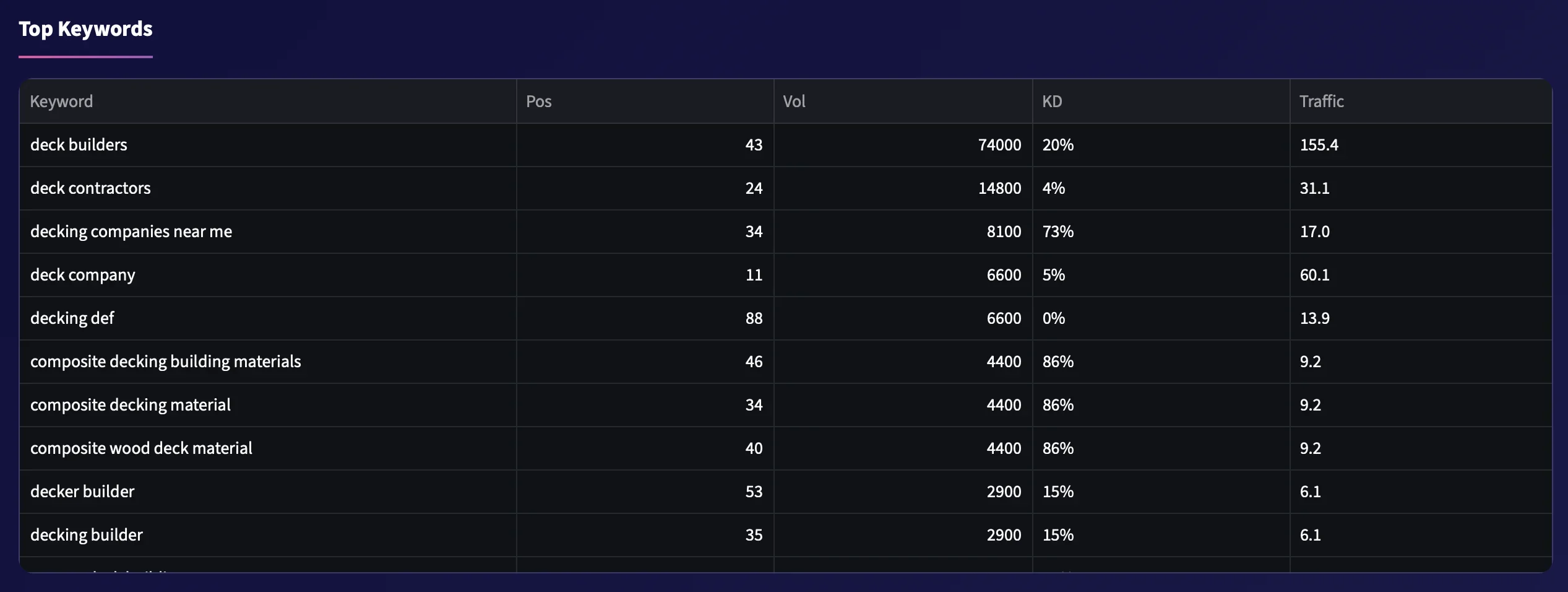
Screenshot from SSARS, my custom SEO dashboard
What is Keyword Research?
Keyword research is figuring out what words and phrases people type into Google when they're looking for something. That's it. No magic, just understanding your customers.
Here's why it matters: if you create content about "best running shoes" but everyone's searching for "running shoes for beginners," you're shouting into the void. Keyword research tells you exactly what language your customers use.
The goal isn't to stuff keywords everywhere. It's to understand what people want, then create content that actually helps them.
The 4 Metrics That Matter
When evaluating keywords, focus on these four things:
Search Volume
How many people search for this term monthly. Higher isn't always better - a keyword with 100 searches from your exact customers beats 10,000 random searches.
Keyword Difficulty
How hard it is to rank for this keyword. New sites should target lower difficulty keywords first, then work up to the competitive ones.
Relevance
Does this keyword actually relate to what you offer? A plumber shouldn't target "electrician near me" even if it has great metrics.
Search Intent
What does the searcher actually want? This is the most important metric and the one most people ignore.
Understanding Search Intent
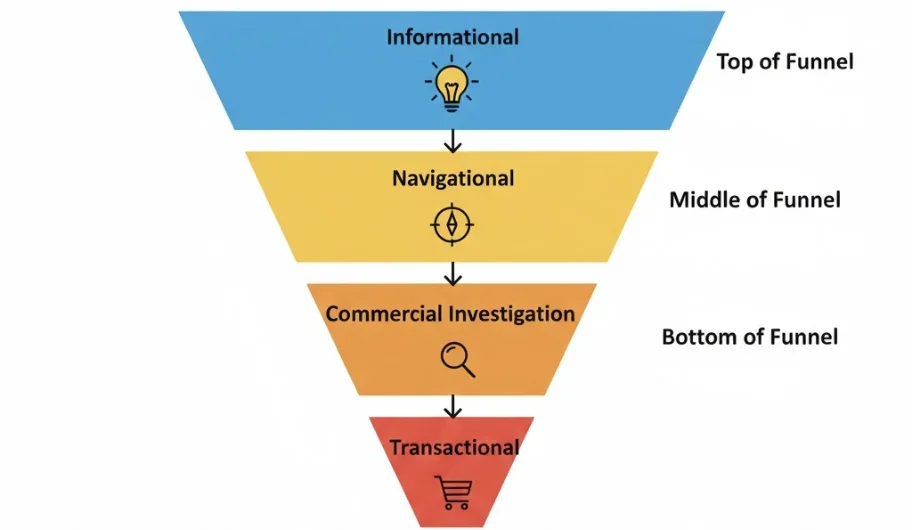
Search intent is WHY someone is searching. Get this wrong and nothing else matters. There are 4 types:
The person wants to go to a specific website. Think "Amazon," "Facebook login," or "Apple website." They already know where they want to go.
Example: "spotify login" - they just want to get to Spotify
The person wants to learn something. They're not looking to buy - they want information. "How to train a puppy," "what is SEO," "best way to cook steak."
Example: "how to change a tire" - they want instructions, not a mechanic
The person is researching before buying. They're comparing options, reading reviews, looking at "best X" lists. Close to buying but not quite there yet.
Example: "best running shoes 2026" - researching but not ready to click "buy"
The person is ready to buy or take action. "Buy Nike Air Max," "plumber near me," "sign up for Netflix." Credit card is basically in hand.
Example: "buy iPhone 16 Pro" - they know what they want, just need to purchase
Why This Matters for Your Business
Informational keywords often have way more search volume than commercial or transactional ones. And here's the thing - they can still lead to purchases. If someone reads a great article on your site about "how to train a puppy" and it's genuinely helpful, they're more likely to trust you enough to buy from you later. That's content marketing.
Where to Place Your Keywords
Once you've found your keywords, you need to actually use them. But here's the thing - forcefully stuffing keywords everywhere will hurt you. Google's smarter than that. Place them strategically in these spots:
Title Tag
The most important place. Keep it under 60 characters, include your keyword naturally, and add your brand name at the end.
Meta Description
Under 160 characters. Include your keyword and write it like an ad - make people want to click. No keyword stuffing or ALL CAPS nonsense.
URL Slug
Keep it short, use hyphens between words, and include your keyword. /keyword-research-guide is better than /article123 or /this-is-my-really-long-url-about-seo
H1 Heading
Your main headline on the page. Should include your primary keyword and clearly tell readers what the page is about.
H2 Headings
Include your keyword in at least one H2. Secondary keywords work great in H3s and other subheadings.
Introduction
Get your keyword in the first 100 words of your content. Don't force it - just make sure it appears naturally early on.
Image Alt Text & File Names
Describe your images and include keywords where relevant. This helps with Google Image search traffic. Use descriptive file names too - keyword-research-chart.jpg beats IMG_12345.jpg.
Competitor Keyword Analysis
Why start from scratch when you can see what's already working? Competitor keyword analysis shows you what keywords your competitors rank for - and where the gaps are.
How to Do It:
- 1.List your top 3-5 competitors (who shows up when you search your main keywords?)
- 2.Use a tool like Semrush, Ahrefs, or even free tools to see their top keywords
- 3.Look for keyword gaps - keywords they rank for that you don't
- 4.Find opportunities where they rank poorly but the keyword is relevant to you
Don't just copy your competitors. Use this to find opportunities they're missing and content gaps you can fill better than them.
Before You Create Any Page
Before you write a single word, ask yourself these questions:
What type of page do I need?
Blog post? Service page? Product page? Landing page? The content type should match the search intent.
What subtype should it be?
A how-to guide? A listicle? A comparison? A case study? Look at what's ranking and match the format.
What topics should I cover?
Look at the top-ranking pages. What subtopics do they all cover? That's your minimum. Then add more value.
How long should it be?
Long enough to fully cover the topic, short enough to keep attention. Check competitor content length as a baseline.
Keyword Research Mistakes to Avoid
Targeting only high-volume keywords
High volume usually means high competition. Mix in lower-volume, lower-competition keywords you can actually rank for.
Ignoring search intent
Creating a sales page for an informational keyword will never rank. Always match your content to what searchers actually want.
Keyword stuffing
Cramming keywords everywhere doesn't help - it hurts. Write for humans first, optimize for search engines second.
Not considering local intent
If you're a local business, "plumber" and "plumber Minneapolis" are completely different keywords with different strategies.
Frequently Asked Questions
What is keyword research?
Keyword research is finding and analyzing the words people type into search engines. It helps you understand what potential customers search for so you can create content that matches.
What are the 4 types of search intent?
Navigational (looking for a specific site), Informational (seeking knowledge), Commercial (researching before buying), and Transactional (ready to purchase).
Where should I put keywords?
Title tag, meta description, URL slug, H1 heading, at least one H2, the introduction, image alt text, and naturally throughout the content.
How long should title tags be?
Under 60 characters to prevent getting cut off in search results. Include your keyword naturally and add your brand name at the end.
Need Help With Keyword Research?
Keyword research is the foundation of any SEO strategy. I can help you find the right keywords and create content that actually ranks.