
What is Schema Markup?
Schema markup is code (usually JSON-LD) that you add to your website to help search engines understand what your content is about. Think of it as a translator between your content and search engines.
Without schema, Google has to guess what your page is about. With schema, you're explicitly telling Google "this is a local business," "this is a product with a price of $99," or "these are frequently asked questions."
Why AI Loves Schema
AI systems use schema to understand not just content but context. Schema helps identify content type (opinion vs review), shows author expertise, displays publish dates, and highlights ratings. It's becoming more important as AI search grows.
Why Use Schema Markup?
Rich Snippets
Get stars, prices, FAQs, and other enhanced elements in search results. These stand out and get more clicks.
Better Understanding
Help Google understand exactly what your content is about. Less guessing means more accurate rankings.
Higher CTR
Rich snippets increase click-through rates. More visual real estate in search results = more clicks.
AI Ready
AI search and assistants rely heavily on structured data. Schema prepares your content for the AI-driven future.
Most Important Schema Types
There are hundreds of schema types, but these are the ones that matter most for local businesses:
LocalBusiness Schema
Essential for any local business. Includes your name, address, phone, hours, and service area. Helps you show up in local search and maps.
Best for: Any business with a physical location or service area
FAQ Schema
Marks up frequently asked questions. Can display expandable Q&As directly in search results, taking up more space.
Best for: Service pages, product pages, any page with Q&As
Article Schema
For blog posts and articles. Includes author, publish date, and headline. Helps content appear in Google News and Top Stories.
Best for: Blog posts, news articles, guides
Product Schema
For e-commerce. Shows price, availability, and reviews directly in search results. Critical for online stores.
Best for: Product pages, e-commerce sites
Review / AggregateRating Schema
Shows star ratings in search results. Can be for products, services, or your overall business rating.
Best for: Products, services with reviews
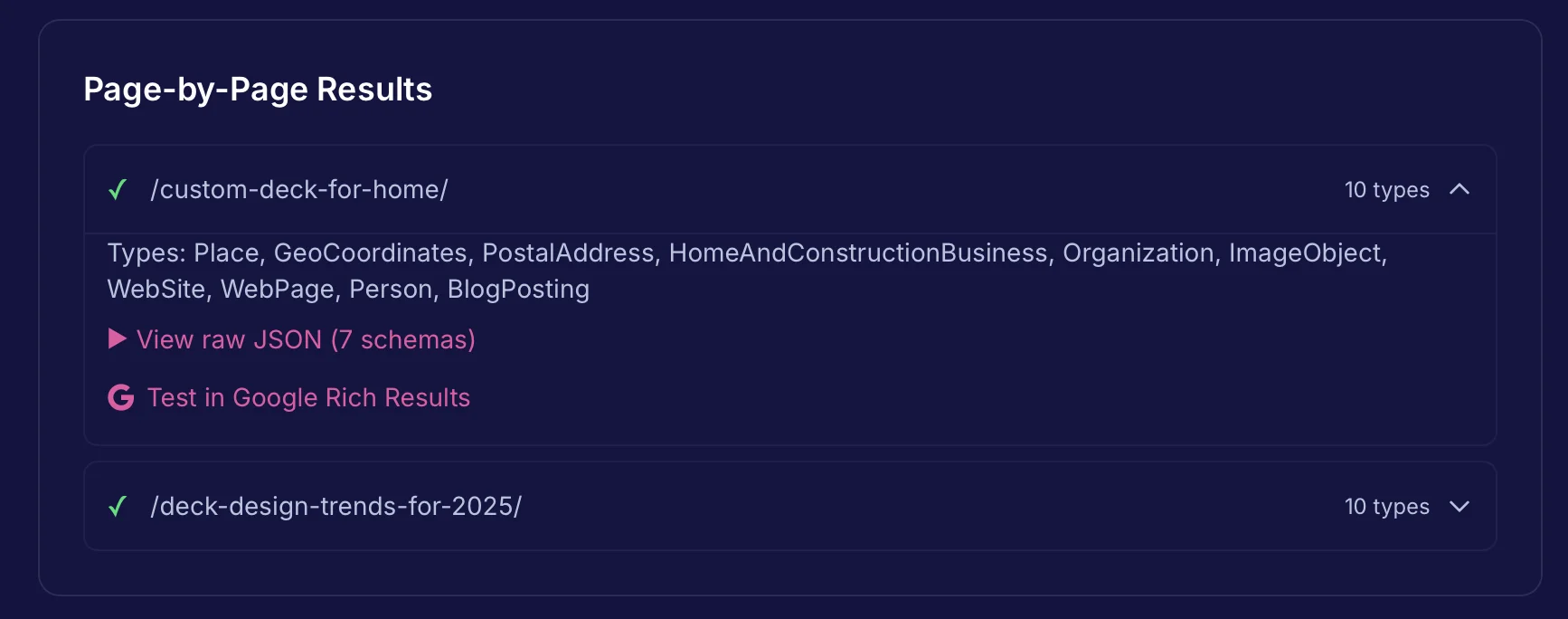
Results from our free schema markup generator tool
How to Add Schema to Your Site
The easiest method is JSON-LD, which is just a script tag you add to your page:
Choose Your Schema Type
Decide what type of content you're marking up. LocalBusiness for your homepage, Article for blog posts, FAQ for Q&A sections, etc.
Generate the Code
Use a schema generator tool or write JSON-LD manually. Google has documentation with examples for every schema type.
Add to Your Page
Paste the JSON-LD script in your page's head or body. Most CMS platforms have plugins that make this easier.
Test Your Schema
Use Google's Rich Results Test to validate your schema. It'll show errors and preview how your rich snippet might look.
Schema Mistakes to Avoid
Marking up content that doesn't exist
Your schema must match visible content on the page. Don't add FAQ schema for questions that aren't actually on the page.
Fake reviews or ratings
Never add review schema for reviews that don't exist. Google can penalize you and remove rich snippets entirely.
Using the wrong schema type
A blog post isn't a Product. A service page isn't an Article. Use the schema type that actually matches your content.
Frequently Asked Questions
What is schema markup?
Schema markup is code that helps search engines understand your content. It uses a standardized vocabulary to describe things like businesses, products, reviews, and FAQs in a way machines can read.
Does schema markup help SEO?
Yes, indirectly. While not a direct ranking factor, schema helps search engines understand your content and can earn you rich snippets, which increase click-through rates.
What are the most important schema types?
For most businesses: LocalBusiness, FAQ, Article, Product, and Review schema. The best types depend on your content and business type.
Need Help With Schema Markup?
We implement schema markup as part of our technical SEO services. Get structured data that helps you stand out in search results.